

IS YOUR WEBSITE AT RISK?Website ADA Accessibility
In 2024 there were more than 4500 ADA Title III lawsuits against companies with websites that were not accessible.
You may have heard about recent ADA lawsuits targeting large companies such as Domino’s (Robles v. Domino’s Pizza), Five Guys (Lucia Markett v. Five Guys), Hobby Lobby (Sean Gorecki v. Hobby Lobby), Winn-Dixie (Gil vs. Winn-Dixie) where the grocery store chain had to pay $105K to settle the lawsuit, and most notably National Federation of the Blind v. Target Corporation where Target spent millions in legal fees over 12 years and eventually still had to pay 6 million in damages to the plaintiff.
These companies weren’t accused of failing to build a wheelchair ramp or install handrails in the restrooms — common allegations in ADA lawsuits in years past — but simply that their websites couldn’t be used by people with certain disabilities.
Each of those cases involved visually impaired people trying to access the company’s website, and the lawsuits were all filed in FEDERAL court under ADA Title III – the “public access” section of the Americans with Disabilities Act. We are not attorneys, so to better understand the scope of this risk to our clients I have had extensive discussions with lawyers, industry experts, consultants and companies that specialize in ensuring websites are fully ADA compliant.
In addition to the large companies that have had issues with this, recently a small shoe store in Clearwater, FL was involved in a website accessibility lawsuit. They are a “mom & pop" shop – as are many of our clients – so this one really hit home for us. A small business that did everything they could to survive the last few years and now hoping to expand their business again, only to get hit with a website accessibility lawsuit that could cost them $10-$20k to resolve.
These companies weren’t accused of failing to build a wheelchair ramp or install handrails in the restrooms — common allegations in ADA lawsuits in years past — but simply that their websites couldn’t be used by people with certain disabilities.
Each of those cases involved visually impaired people trying to access the company’s website, and the lawsuits were all filed in FEDERAL court under ADA Title III – the “public access” section of the Americans with Disabilities Act. We are not attorneys, so to better understand the scope of this risk to our clients I have had extensive discussions with lawyers, industry experts, consultants and companies that specialize in ensuring websites are fully ADA compliant.
In addition to the large companies that have had issues with this, recently a small shoe store in Clearwater, FL was involved in a website accessibility lawsuit. They are a “mom & pop" shop – as are many of our clients – so this one really hit home for us. A small business that did everything they could to survive the last few years and now hoping to expand their business again, only to get hit with a website accessibility lawsuit that could cost them $10-$20k to resolve.
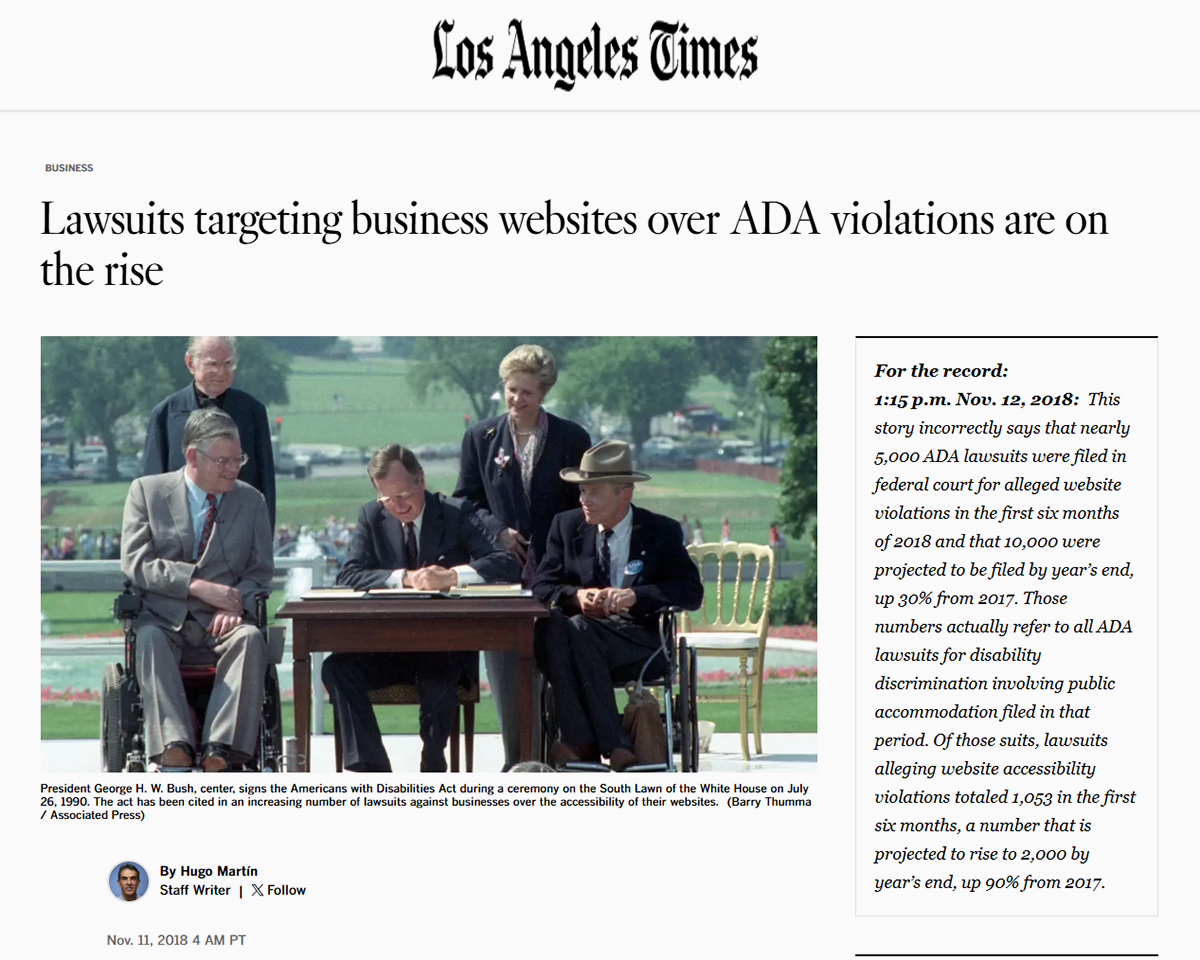
In another case, the Avanti Hotel in Palm Springs got hit with a lawsuit where the plaintiff sought $13k in damages and for the hotel to be ordered to make the required changes to their website. The hotel’s attorney said that it would likely cost upwards of $25k in damages and work to the website, PLUS potentially tens of thousands in attorney fees if they chose to fight the lawsuit and lost.
In 2024 there were over 4,000 federal cases filed regarding ADA website accessibility, an increase of over 500% in the last five years. As the trend indicates, this is now a very serious problem that businesses of all sizes must address before they fall victim to one of these potentially catastrophic lawsuits.
Especially striking is the fact that based on available ADA Title III lawsuit numbers, website accessibility lawsuits made up over 37% of the ADA Title III lawsuits filed in 2022, up from roughly 25% in 2021.
In 2024 there were over 4,000 federal cases filed regarding ADA website accessibility, an increase of over 500% in the last five years. As the trend indicates, this is now a very serious problem that businesses of all sizes must address before they fall victim to one of these potentially catastrophic lawsuits.
Especially striking is the fact that based on available ADA Title III lawsuit numbers, website accessibility lawsuits made up over 37% of the ADA Title III lawsuits filed in 2022, up from roughly 25% in 2021.
A common theme with these cases is that the plaintiffs were mostly visually impaired persons that couldn’t use their assistive technology (screen reading software) with the company’s website. So, just like building a ramp to bypass stairs into a store, it is now required to make your website accessible to people with disabilities.
Most website accessibility lawsuit cases end with a settlement agreement between the two parties as in Haynes v. Hooters, Braulio Thorne v. Rolex Watch, Bishop v. Amazon.com, Inc., and Aldworth v TD Ameritrade which ended with TD Ameritrade agreeing to remediate their website and pay Aldworth punitive damages as well as court costs and attorney fees. ADA website lawsuit settlements may or may not include damages to the plaintiff, but in all cases the defendant must then ensure that their website provides equal access to persons with disabilities to avoid being the target of additional lawsuits.
Most website accessibility lawsuit cases end with a settlement agreement between the two parties as in Haynes v. Hooters, Braulio Thorne v. Rolex Watch, Bishop v. Amazon.com, Inc., and Aldworth v TD Ameritrade which ended with TD Ameritrade agreeing to remediate their website and pay Aldworth punitive damages as well as court costs and attorney fees. ADA website lawsuit settlements may or may not include damages to the plaintiff, but in all cases the defendant must then ensure that their website provides equal access to persons with disabilities to avoid being the target of additional lawsuits.
As you read this you’re probably thinking “Why don’t companies just build a website that is ADA compliant in the first place?” That’s a great question. When we build a website for a client we work hard to check as many accessibility boxes as we can, however achieving and maintaining compliance that way means that every time the website is updated it must be checked and fixed again. Website ADA compliance is not a “one and done" service, rather an ongoing maintenance requirement. The fact is – it’s impossible to build a website that is fully compliant forever, because the website content will change and the laws concerning website accessibility may change as well. Since content on a business website must change frequently in order for the site to be an effective marketing tool, we needed to find a dynamic solution that automatically kept the website in compliance.
So, what are your choices?
There are a few options:
- Do nothing…and risk a lawsuit that could put you out of business.
- Take your website down…and lose all visibility in the online marketplace.
- Hire an ADA compliance firm like SiteImprove ($5k+/month) or AudioEye ($10k+/year).
Or…
- Use Breakout’s simple, cost-effective solution for full WCAG 2.1 & 2.2 Level AA website compliance.
- One simple line of code that can be added to any website in just a few minutes.
- Full featured accessibility tools for people with disabilities:
- Screen Reader (for blind users)
- Vision Impaired Profile
- Seizure Safe Profile
- Cognitive Disability Profile
- Keyboard Navigation (for motor impaired users)
- ADHD Profile (removal of on-screen distractions)
Test our website accessibility solution right now by clicking the blue icon in the lower left corner of this screen…
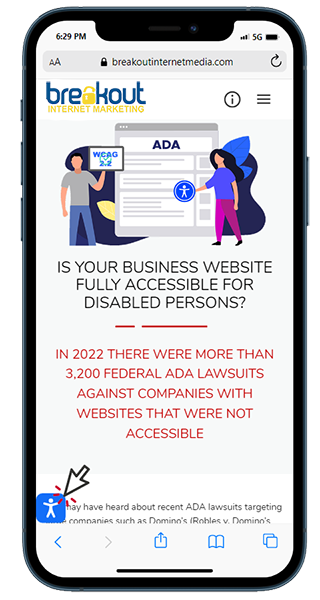
We have partnered with the top AI & ADA Accessibility experts in the industry to bring our clients an on-screen tool that provides a fully compliant solution to their existing website without a total re-work. It’s literally one line of code. And best of all, we’re able to provide this for a very small monthly subscription fee, which all things considered is a tiny price to pay to get the peace of mind of becoming instantly compliant, avoid a lawsuit like the ones detailed above, and most importantly warn off any would-be scam attorneys from targeting you. Once they see our tool automatically providing comprehensive ADA accessibility on your website, they will move along to the next unsuspecting business owner who unfortunately hasn’t taken this step to protect themselves.
To demonstrate the functionality and ease-of-use of this solution, we’d like to offer you a free 30-day trial to demonstrate how well it will work on your website. There is no signup required and no strings attached – we’ll provide you one simple line of code with instructions on how to add it to your website so that our accessibility tool will display every page. We can even help you install it if you’d like. If after trying it out for a week you decide you don’t want it, simply delete the code from your site and the tool will disappear. If you decide to keep it, we’ll set you up with a simple no-contract monthly subscription that provides full accessibility to your users while protecting your business from devastating lawsuits like those mentioned above.
To demonstrate the functionality and ease-of-use of this solution, we’d like to offer you a free 30-day trial to demonstrate how well it will work on your website. There is no signup required and no strings attached – we’ll provide you one simple line of code with instructions on how to add it to your website so that our accessibility tool will display every page. We can even help you install it if you’d like. If after trying it out for a week you decide you don’t want it, simply delete the code from your site and the tool will disappear. If you decide to keep it, we’ll set you up with a simple no-contract monthly subscription that provides full accessibility to your users while protecting your business from devastating lawsuits like those mentioned above.
Mitigate the risk of being targeted by an expensive lawsuit.
Make your website fully accessible to people with disabilities.
Get BreakoutADA today.
Still have questions?Get In Touch...
CALL NOW
(313) 757-1425
CALL NOW
Mon - Sat 8AM - 6PM
BY APPOINTMENT ONLY
120 S Main St, Ann Arbor MI 48104
© 2025 Breakout Internet Marketing
Terms of Service | Privacy Policy